A Real Los Angeles Remodel Breakdown
In Los Angeles, kitchens are more than functional spaces.
They are gathering points, design statements, resale drivers, and daily lifestyle hubs.
In Los Angeles, kitchens are more than functional spaces.
They are gathering points, design statements, resale drivers, and daily lifestyle hubs.
Yet many homeowners share the same frustration:
“My kitchen isn’t small… but it feels small.”
“It’s bright during the day, but dull overall.”
“It works, but it doesn’t feel luxurious.”
“My kitchen isn’t small… but it feels small.”
“It’s bright during the day, but dull overall.”
“It works, but it doesn’t feel luxurious.”
Interestingly, the perception of space, light, and luxury is rarely determined by square footage alone.
A kitchen can remain the same size yet feel dramatically larger, brighter, and more refined through strategic design decisions.
In this breakdown, we’ll analyze a real Los Angeles kitchen remodel that achieved exactly that — transforming an ordinary kitchen into a space that feels:
✨ More open
✨ More luminous
✨ More elegant
✨ More valuable
Let’s explore why it works.
The Homeowner’s Original Challenge
Like many LA homes, this kitchen had good bones:
✔ Decent footprint
✔ Functional layout
✔ Natural light potential
But it suffered from common issues:
• Visual heaviness
• Limited perceived space
• Inconsistent finishes
• Underutilized lighting
• Lack of focal hierarchy
• Limited perceived space
• Inconsistent finishes
• Underutilized lighting
• Lack of focal hierarchy
Nothing was “wrong” structurally.
But aesthetically and experientially, the kitchen felt tighter, darker, and less inspiring than it should.
But aesthetically and experientially, the kitchen felt tighter, darker, and less inspiring than it should.
Principle #1: Visual Weight Determines Spatial Perception
One of the most misunderstood aspects of kitchen design is visual weight.
Even large kitchens can feel cramped if elements visually dominate the space.
Even large kitchens can feel cramped if elements visually dominate the space.
What Creates Visual Heaviness?
❌ Dark cabinetry everywhere
❌ Bulky upper cabinets
❌ Busy patterns
❌ Thick trim details
❌ Poor color balance
The Remodel Solution
This kitchen uses:
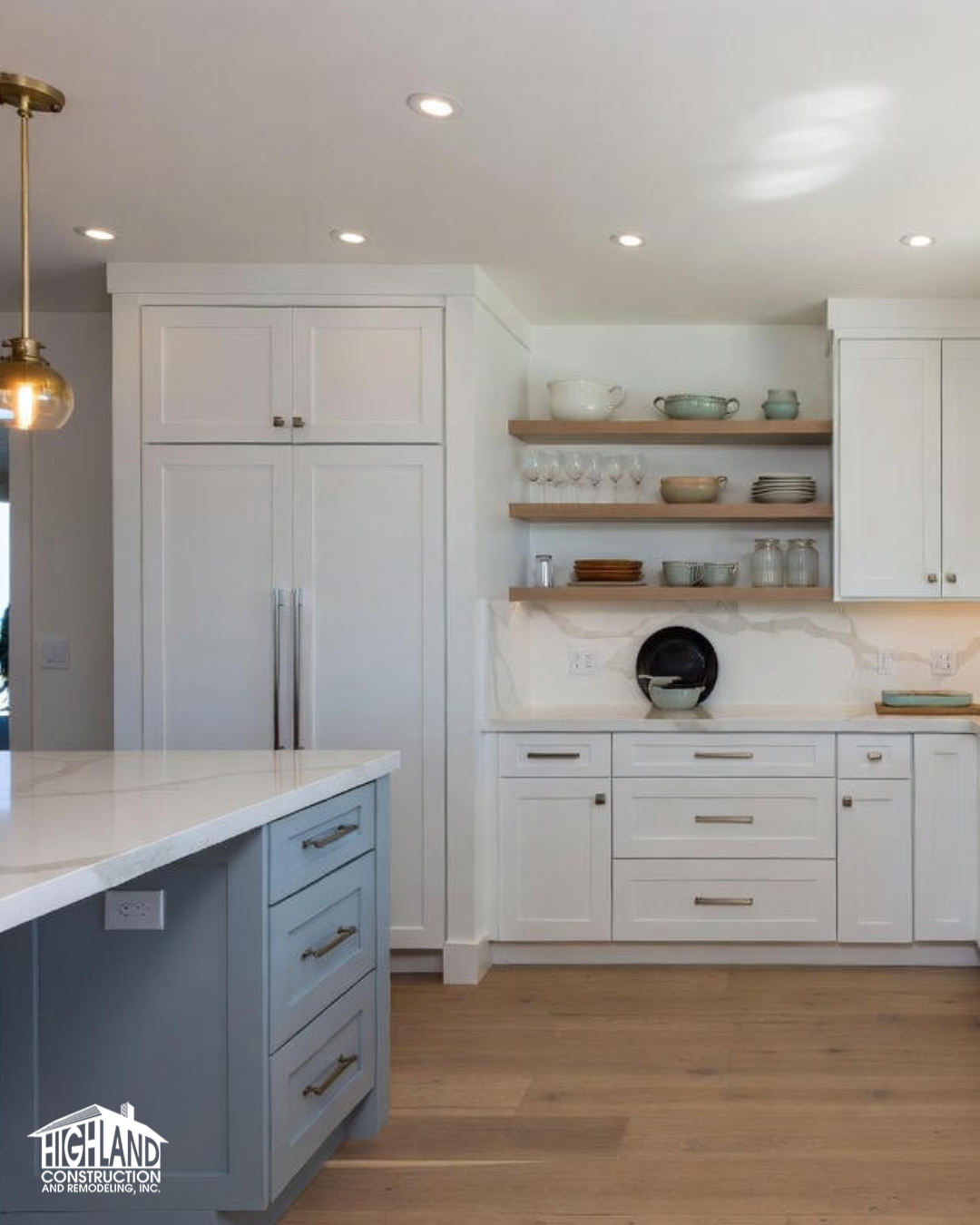
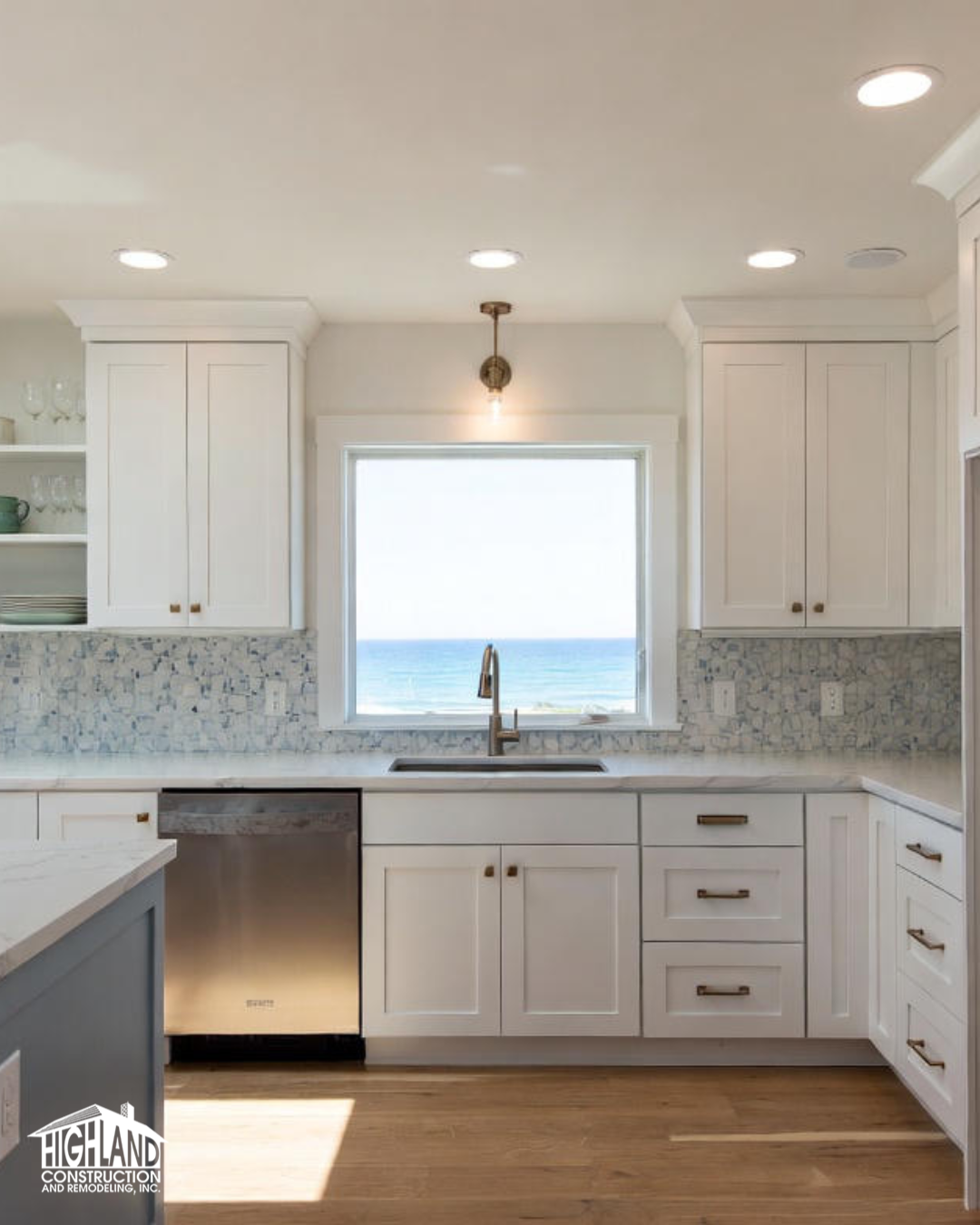
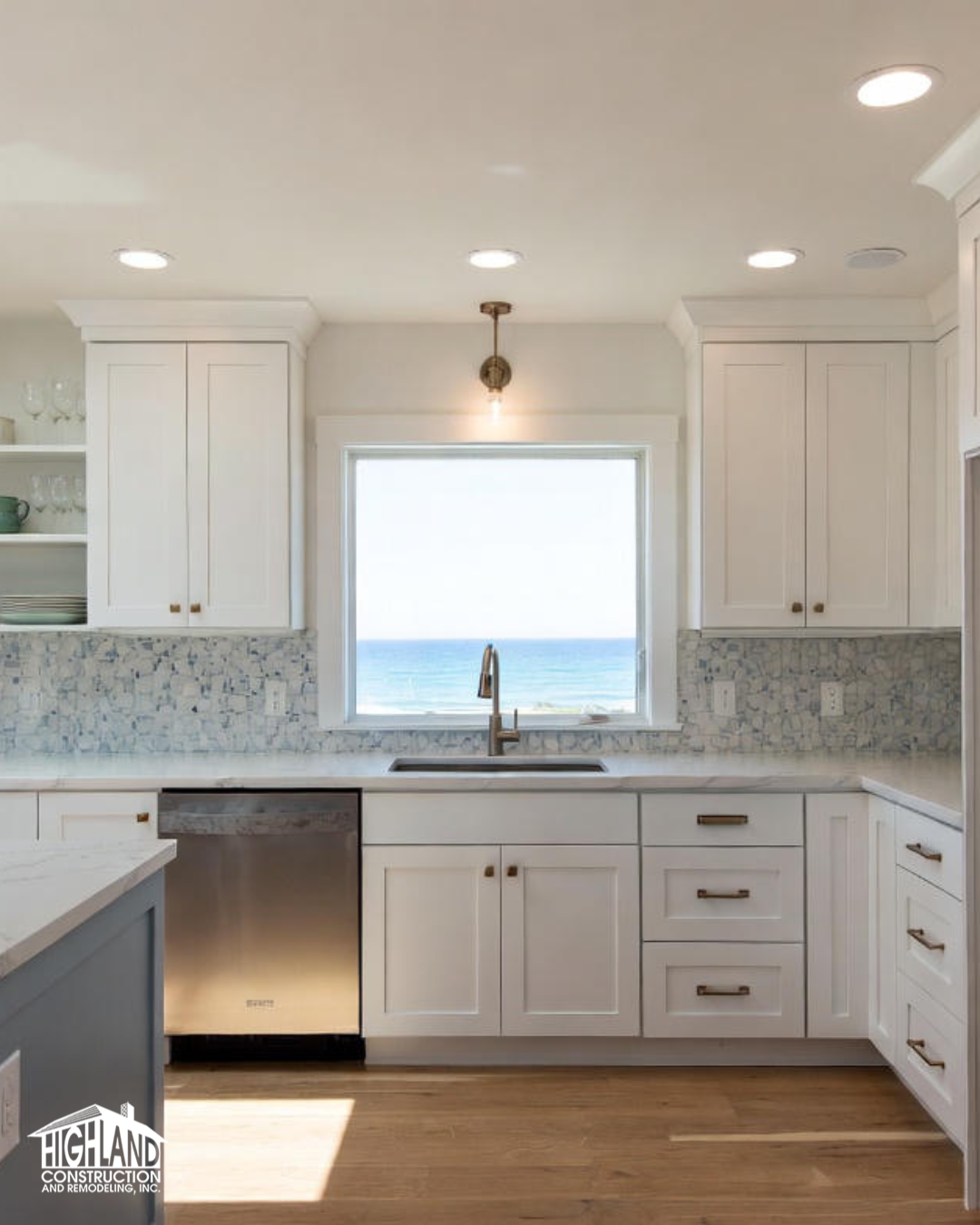
✔ Crisp white shaker cabinetry
✔ Clean-lined profiles
✔ Balanced contrast
✔ Minimal ornamentation
✔ Clean-lined profiles
✔ Balanced contrast
✔ Minimal ornamentation
White cabinetry reflects light and visually recedes, making walls feel farther apart.
But white alone isn’t enough.
But white alone isn’t enough.
Principle #2: Contrast Adds Depth (Without Shrinking the Room)
Many homeowners fear contrast:
“Won’t darker elements make the kitchen feel smaller?”
Only if used incorrectly.
Smart Contrast Strategy Used Here
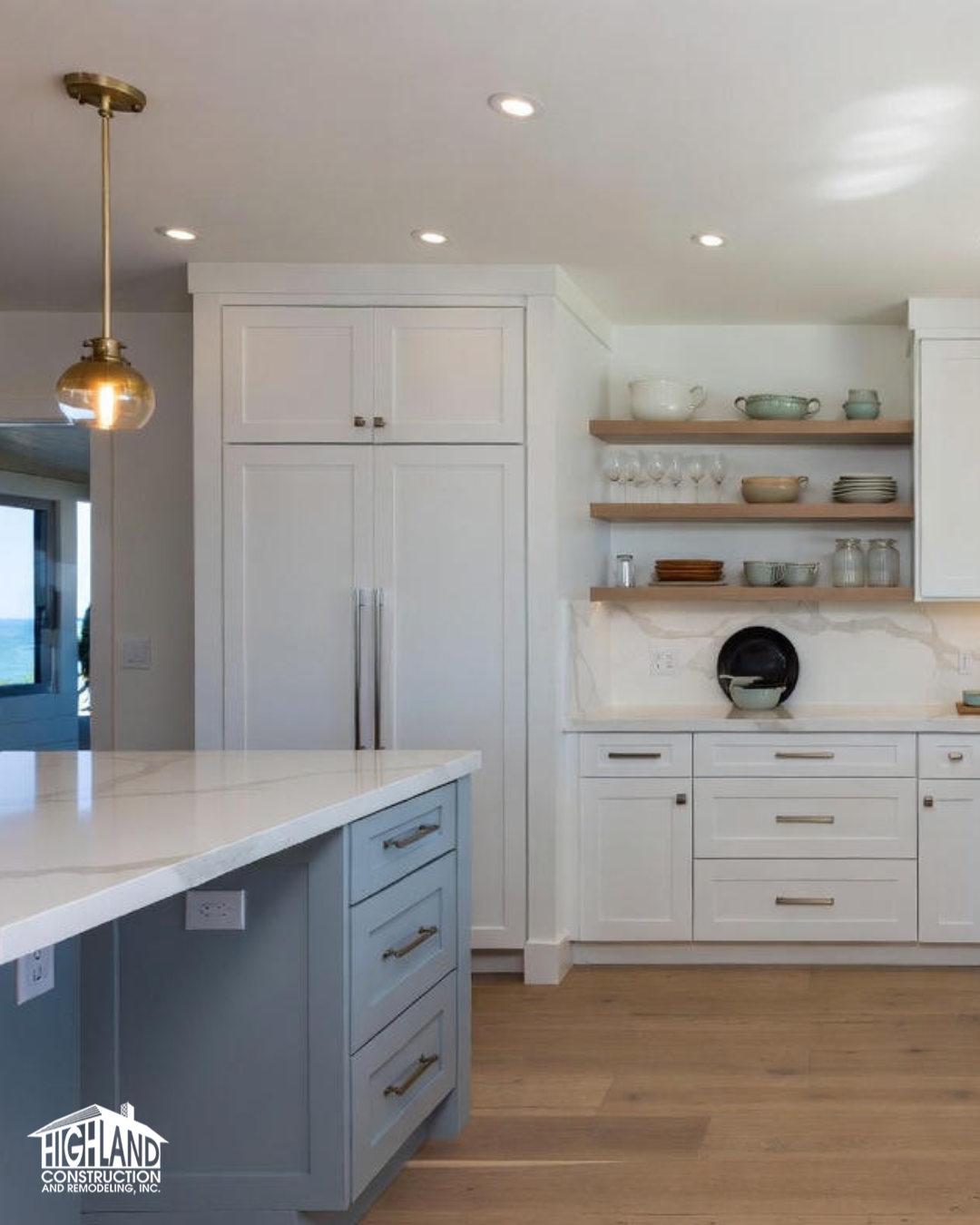
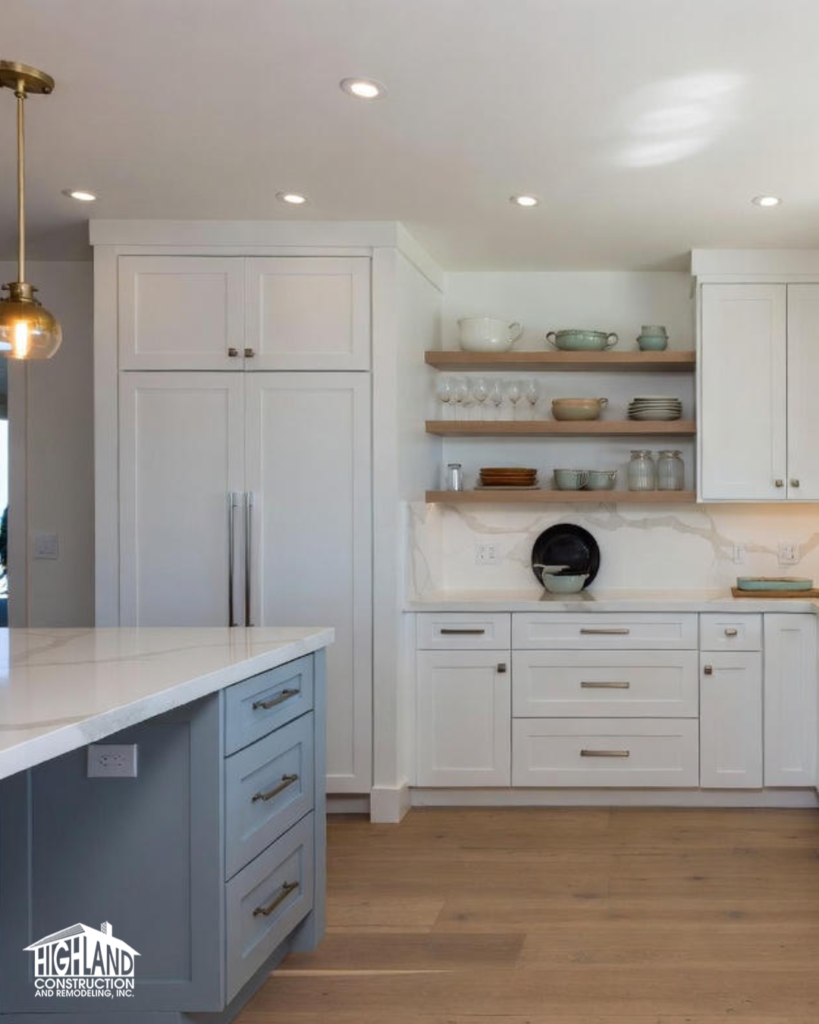
✔ Soft blue island
✔ Warm brass hardware
✔ Natural wood shelving
✔ Neutral flooring
Instead of overwhelming the space, contrast was anchored to a single focal zone — the island.
Result:
• The perimeter stays airy
• The island becomes sculptural
• The eye perceives depth
• The room feels layered, not busy
Contrast creates dimension — which the brain interprets as spaciousness.
• The perimeter stays airy
• The island becomes sculptural
• The eye perceives depth
• The room feels layered, not busy
Contrast creates dimension — which the brain interprets as spaciousness.
Principle #3: Islands as Spatial Anchors
A poorly designed island can choke circulation.
A well-designed island enhances openness.
Why This Island Works
✔ Soft muted blue tone
✔ Clean waterfall edge
✔ Slim hardware
✔ Proper clearance spacing
✔ Clean waterfall edge
✔ Slim hardware
✔ Proper clearance spacing
The color adds personality without visual aggression.The waterfall countertop elongates horizontal sightlines — a subtle but powerful luxury cue.
Principle #4: Open Shelving = Psychological Air
Upper cabinets maximize storage but reduce visual breathing room.
Open shelving, when done right:
✔ Lightens the wall
✔ Adds display opportunity
✔ Creates rhythm
✔ Enhances depth
Key to Success
This remodel avoided cluttered styling.
Shelves feature:
• Neutral ceramics
• Glassware
• Balanced spacing
• Repetition
Minimalist styling prevents visual chaos.
• Neutral ceramics
• Glassware
• Balanced spacing
• Repetition
Minimalist styling prevents visual chaos.
Principle #5: Light Is Layered, Not Singular
Brightness is not just about windows.
A luminous kitchen blends:
✔ Natural light
✔ Ambient light
✔ Task light
✔ Accent light
Lighting Techniques Used
✔ Recessed ceiling lights
✔ Under-cabinet illumination
✔ Brass pendant fixture
✔ Daylight from picture window
Under-cabinet lighting eliminates shadows — making counters feel wider.Even lighting distribution expands perceived volume.
Principle #6: The Power of the Picture Window
Few features transform a kitchen like a large window.
Why It’s So Effective
✔ Connects interior to exterior
✔ Extends visual boundaries
✔ Floods space with daylight
✔ Adds emotional uplift
In LA, where outdoor views are valuable, windows amplify both design and lifestyle appeal.
The eye reads beyond walls → the room feels larger.
Principle #7: Hardware as Jewelry
Luxury often lives in the details.
This kitchen uses:
✔ Warm brass hardware
✔ Clean modern pulls
✔ Matching brass pendant
✔ Warm brass hardware
✔ Clean modern pulls
✔ Matching brass pendant
Hardware provides:
• Warmth
• Texture
• Sophistication
• Contrast refinement
• Texture
• Sophistication
• Contrast refinement
Mixed correctly, metals elevate rather than clutter.
Principle #8: Floor Continuity Expands Space
The wide-plank wood flooring:
✔ Grounds the space
✔ Adds warmth
✔ Provides visual flow
✔ Avoids harsh contrast
Continuous flooring visually stretches the room.
Small tiles or busy patterns could fragment the perception.
✔ Grounds the space
✔ Adds warmth
✔ Provides visual flow
✔ Avoids harsh contrast
Continuous flooring visually stretches the room.
Small tiles or busy patterns could fragment the perception.
Principle #9: Color Psychology & Emotional Experience
White + soft blue + warm wood + brass =
✨ Calm
✨ Airy
✨ Relaxed
✨ Refined
✨ Calm
✨ Airy
✨ Relaxed
✨ Refined
Color harmony influences emotional response.
A kitchen that feels good naturally feels more luxurious.
A kitchen that feels good naturally feels more luxurious.
Principle #10: Luxury = Restraint + Precision
Luxury design is rarely loud.
It’s defined by:
✔ Proportion
✔ Balance
✔ Material integrity
✔ Cohesion
✔ Negative space
✔ Balance
✔ Material integrity
✔ Cohesion
✔ Negative space
This remodel avoided:
❌ Excess ornamentation
❌ Competing colors
❌ Trend overload
❌ Competing colors
❌ Trend overload
Result → timeless sophistication.
How Homeowners Benefit From This Approach
Beyond aesthetics, these design choices improve:
✔ Daily comfort
✔ Workflow efficiency
✔ Lighting usability
✔ Storage accessibility
✔ Resale value
✔ Workflow efficiency
✔ Lighting usability
✔ Storage accessibility
✔ Resale value
A kitchen that feels bigger and brighter enhances everyday living.
Common Mistakes That Make Kitchens Feel Smaller
Many LA kitchens feel constrained due to:
❌ Too many cabinet colors
❌ Dark upper cabinets
❌ Poor lighting layout
❌ Overcrowded islands
❌ Heavy backsplash patterns
❌ Dark upper cabinets
❌ Poor lighting layout
❌ Overcrowded islands
❌ Heavy backsplash patterns
Even expensive remodels can fail without strategic planning.
ROI Impact in Los Angeles
Well-designed kitchen remodels often deliver:
✔ Strong resale influence
✔ Faster buyer interest
✔ Higher perceived home value
✔ Faster buyer interest
✔ Higher perceived home value
Buyers don’t just evaluate size — they evaluate feeling.
Spacious, bright kitchens photograph better, show better, and sell better.
Key Takeaway: Perception Beats Square Footage
You don’t always need a larger kitchen.
You need:
✔ Better light distribution
✔ Visual weight balance
✔ Smart contrast
✔ Cohesive materials
✔ Thoughtful focal points
✔ Visual weight balance
✔ Smart contrast
✔ Cohesive materials
✔ Thoughtful focal points
Design shapes experience.
Experience shapes value.
This Los Angeles kitchen remodel proves a powerful truth:
A kitchen doesn’t need to be massive to feel expansive.
It needs to be intelligently designed.
A kitchen doesn’t need to be massive to feel expansive.
It needs to be intelligently designed.
Through color strategy, lighting, materials, and restraint, this space now feels:
✨ Bigger
✨ Brighter
✨ More elegant
✨ More luxurious
Without unnecessary complexity.
✨ Brighter
✨ More elegant
✨ More luxurious
Without unnecessary complexity.
Thinking About Remodeling Your Kitchen?
If your kitchen feels:
• Smaller than it should
• Darker than you’d like
• Outdated or uninspiring
• Smaller than it should
• Darker than you’d like
• Outdated or uninspiring
A professional design-build approach can unlock its true potential.
The transformation often lies not in demolition — but in design intelligence.
The transformation often lies not in demolition — but in design intelligence.