In Los Angeles, homes are often designed to blur the boundary between movement and stillness. The city itself hums with momentum — traffic flowing along Sunset, morning light sliding across hillside glass, evenings painted in warm amber tones. Yet within that energy, there is a growing desire for spaces that feel quiet, grounded, restorative. Spaces that do not compete with the pace of life, but gently counterbalance it.
This bathroom remodel began with exactly that intention.
The homeowners didn’t ask for drama. They didn’t ask for bold color, ornate detailing, or visual spectacle. What they wanted was something far more elusive: calm. A room that would feel like stepping out of Los Angeles without ever leaving home.
They described it in simple terms — “clean,” “warm,” “peaceful,” “modern but not cold.” Words that sound straightforward, yet require extraordinary precision to translate into built form. Because minimalism, when done poorly, can feel empty. And luxury, when done excessively, can feel loud.
The challenge was to create a bathroom that felt both minimal and deeply inviting.
The Original Space
Before the remodel, the bathroom reflected a design language common in older Los Angeles residences. The layout was functional but visually fragmented. Multiple materials competed for attention — small-format tiles, contrasting trim, decorative fixtures that once felt fashionable but now felt dated.
Lighting was uneven. Shadows collected in corners. Reflections were harsh. The vanity felt heavy, anchored awkwardly against the wall. The tub, boxed into its enclosure, lacked presence. Nothing felt cohesive. Nothing felt intentional.
Most importantly, nothing felt relaxing.
Bathrooms are unique among rooms. Unlike kitchens or living spaces, they are intimately tied to ritual — morning transitions, evening decompression, moments of solitude rarely replicated elsewhere in the home. When the design fails to support that emotional function, the disconnect becomes immediately apparent.
The homeowners felt it every day.
A Different Vision
During the design consultation, the direction became clear almost instantly.
The inspiration was not pulled from trends, but from feeling.
They spoke about boutique hotels. About spa retreats. About travel experiences where materials, light, and silence created an atmosphere that slowed the nervous system. They wanted that same sensation — but personal, permanent, architectural.
The vision centered around three guiding principles:
Simplicity. Warmth. Continuity.
No visual noise.
No excessive ornamentation.
No competing design statements.
No excessive ornamentation.
No competing design statements.
Instead, the bathroom would rely on proportion, texture, and light.
Material as Atmosphere
Minimalist spaces succeed or fail on material selection. Without decorative layers to distract the eye, every surface becomes expressive. Texture becomes the language. Tone becomes the emotion.
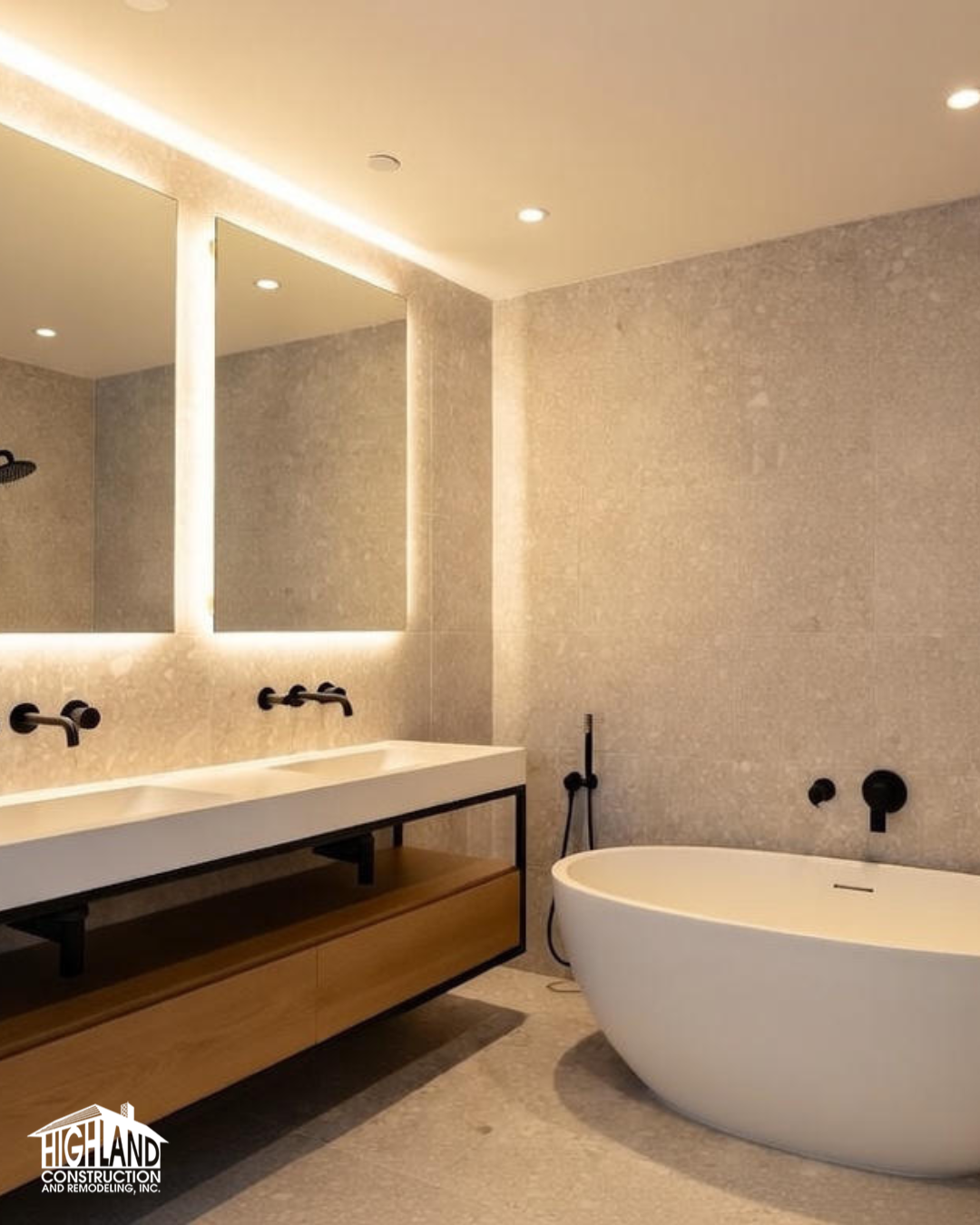
Large-format stone tiles were chosen for both walls and floors.
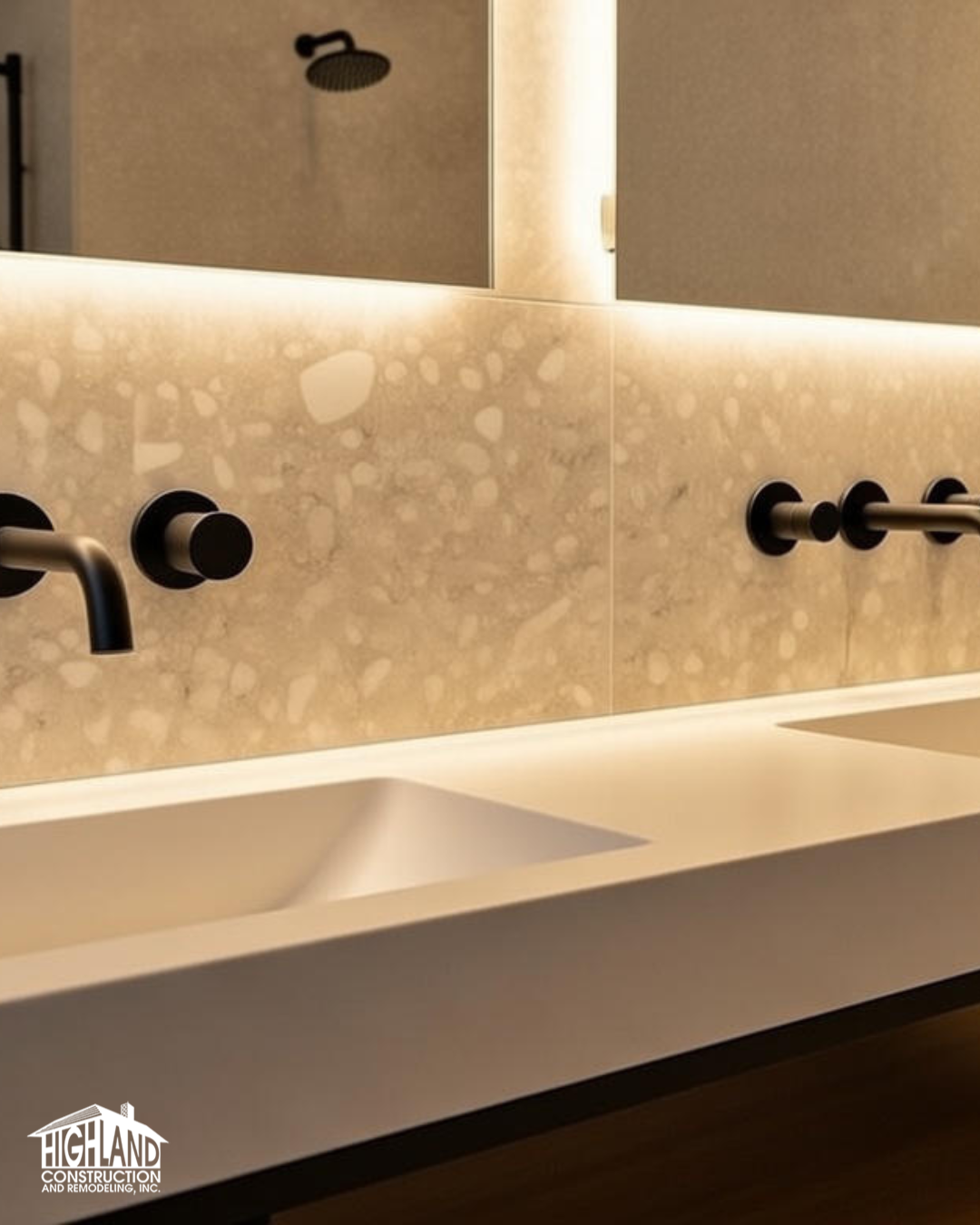
The goal was seamlessness — to eliminate the visual interruption created by small grout lines and busy patterns. The stone’s soft, natural variation introduced movement without chaos. Its neutral warmth created depth without darkness.
Rather than “designing with tile,” the intention was to create a stone envelope — a continuous backdrop that would feel architectural rather than decorative.
The effect is subtle yet transformative.
The room feels quieter because the surfaces are quieter.
The Freestanding Tub: Sculptural Stillness
In the previous layout, the tub existed as a utility. Functional, yes — but visually secondary.
In the new design, the tub became the emotional center.
A sculptural freestanding soaking tub was introduced, its smooth organic form contrasting gently with the linear geometry of the stone walls. Positioned intentionally rather than tucked away, it now reads as an object — almost like a piece of furniture or art.
Matte black wall-mounted fixtures were selected to maintain visual restraint. Their finish provides contrast without glare, grounding the composition while reinforcing the minimalist palette.
In this bathroom, the tub is not simply for bathing.
It is for pause.
Floating the Vanity
One of the most impactful changes came from subtraction rather than addition.
The original vanity sat heavily on the floor, visually compressing the space. By introducing a floating white oak vanity, the room immediately gained a sense of lightness and openness.
The exposed floor beneath allows the eye to travel uninterrupted. The geometry feels cleaner. The proportions feel more generous.
White oak was chosen specifically for its warmth and grain subtlety. In minimalist design, overly dramatic wood patterns can disrupt serenity. Rift-cut oak offers a refined, linear texture that feels calm, modern, and timeless.
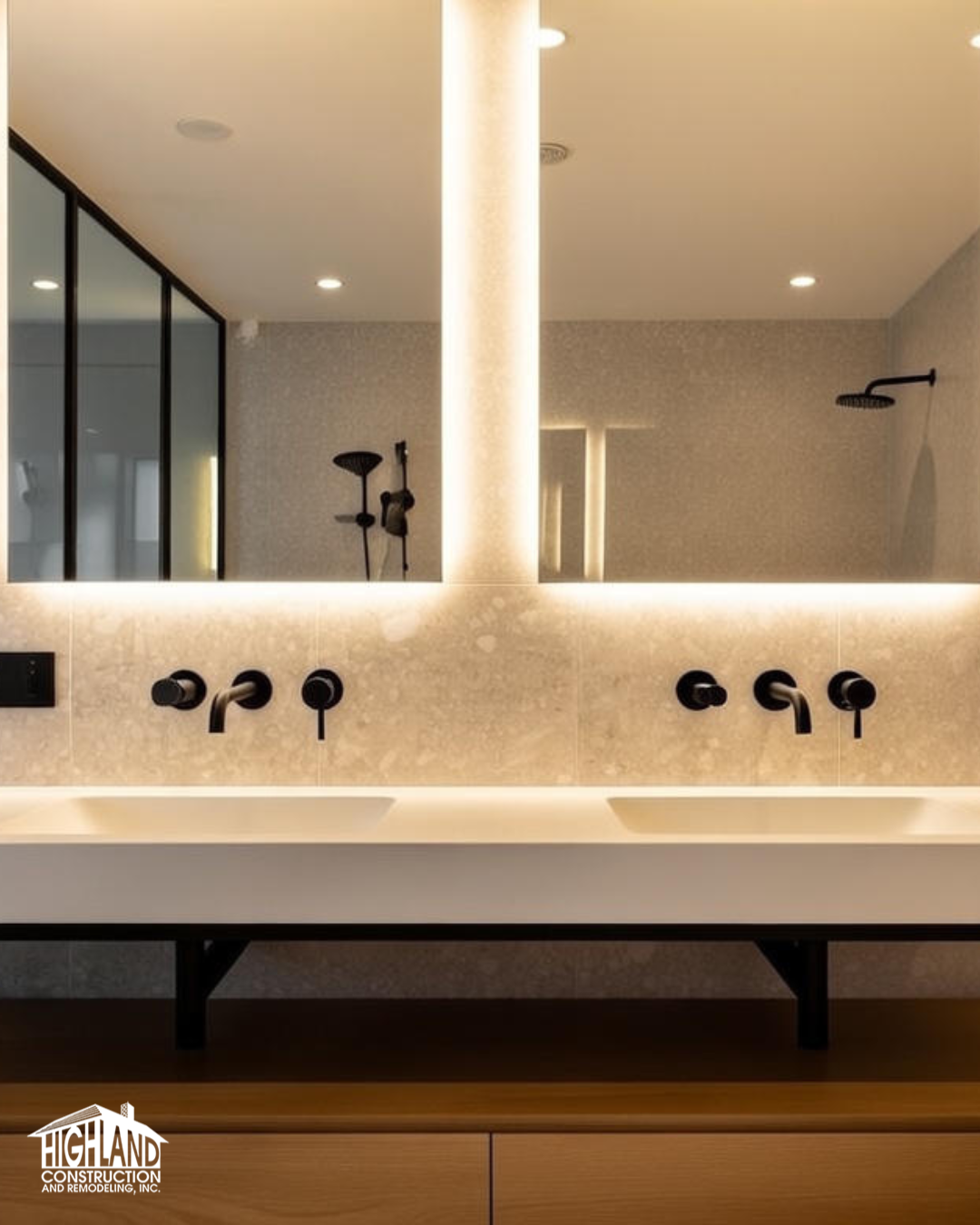
Integrated sinks and wall-mounted faucets further reduce visual clutter.
Every line serves a purpose.
Every element feels deliberate.
Every element feels deliberate.
Lighting: The Invisible Luxury
Luxury in modern interiors is rarely defined by excess. More often, it is defined by how a space makes you feel — and lighting plays a profound role in that experience.
This bathroom relies on layered, concealed illumination.
Backlit mirrors cast a soft ambient glow, eliminating harsh facial shadows while creating a halo-like effect that enhances depth. Recessed ceiling lights provide general illumination without visual distraction. Hidden LED strips introduce warmth along horizontal planes, accentuating textures rather than overpowering them.
There are no decorative chandeliers.
No statement pendants.
No theatrical fixtures.
No statement pendants.
No theatrical fixtures.
The lighting is felt more than seen.
And that is precisely the point.
Matte Black: Controlled Contrast
Contrast in minimalist design must be measured carefully. Too little, and the space becomes flat. Too much, and the serenity dissolves.
Matte black fixtures provide visual anchoring throughout the bathroom.
Faucets. Shower fittings. Tub hardware.
Their presence defines edges, punctuates the neutral palette, and introduces a modern architectural rhythm. Unlike polished finishes, matte black absorbs light rather than reflecting it, preserving the room’s softness.
The contrast feels intentional — never aggressive.
The Emotional Shift
When the remodel was completed, the transformation extended far beyond aesthetics.
The homeowners described something that cannot be captured fully in photographs.
Silence.
Not literal silence — but visual silence.
The absence of cluttered patterns.
The absence of competing materials.
The absence of harsh lighting and visual tension.
The absence of competing materials.
The absence of harsh lighting and visual tension.
The bathroom no longer asked for attention.
It offered relief.
Morning routines felt calmer. Evenings felt slower. The space began to support rituals rather than interrupt them.
This is the often-overlooked power of thoughtful remodeling.
Design doesn’t just change how a room looks.
It changes how life feels inside it.
Minimalism Without Coldness
Perhaps the most delicate balance achieved in this project was warmth within restraint.
Minimalism can easily drift toward sterility when warmth is neglected. Here, the white oak vanity, soft stone textures, and warm ambient lighting work together to create emotional comfort.
The palette remains neutral, yet never flat.
The lines remain clean, yet never rigid.
The atmosphere remains minimal, yet deeply inviting.
The lines remain clean, yet never rigid.
The atmosphere remains minimal, yet deeply inviting.
A Bathroom Designed for Los Angeles Living
Los Angeles homes are increasingly shaped by a desire for spaces that feel restorative. As urban density increases and daily stimulation intensifies, interiors must function not only as environments — but as experiences.
This bathroom was designed as an experience of decompression.
A place where materials soften the senses.
Where light calms rather than energizes.
Where form feels effortless.
Where light calms rather than energizes.
Where form feels effortless.
The Lasting Impact
Unlike trend-driven renovations, this remodel was guided by timeless principles:
Natural materials
Balanced contrast
Architectural clarity
Soft, layered light
Balanced contrast
Architectural clarity
Soft, layered light
The result is a bathroom that will not feel dated in five years — because it was never designed around fleeting fashion.
It was designed around feeling.
And feeling, when done right, is timeless.
Every remodel tells two stories.
One about construction — demolition, installation, materials, precision.
And one about transformation — how a space evolves from functional to meaningful.
This Los Angeles bathroom remodel is ultimately a story about stillness. About designing not for visual noise, but for emotional resonance. About creating a room that doesn’t simply serve daily routines, but elevates them.
Because sometimes, luxury is not defined by what is added.
But by what is quietly removed.